Jun-Hyun Bae*, Taewon Park*, Minho Lee
Kyungpook National University
* Equal Contribution
Abstract
Learning associative reasoning is necessary to implement human-level artificial intelligence even when a model faces unfamiliar associations of learned components. However, conventional memory augmented neural networks (MANNs) have shown degraded performance on systematically different data since they lack consideration of systematic generalization. In this work, we propose a novel architecture for MANNs which explicitly aims to learn recomposable representations with a modular structure of RNNs. Our method binds learned representations with a Tensor Product Representation (TPR) to manifest their associations and stores the associations into TPR-based external memory. In addition, to demonstrate the effectiveness of our approach, we introduce a new benchmark for evaluating systematic generalization performance on associative reasoning, which contains systematically different combinations of words between training and test data. From the experimental results, our method shows superior test accuracy on systematically different data compared to other models. Furthermore, we validate the models using TPR by analyzing whether the learned representations have symbolic properties.
Overview
We propose a novel architecture combining a modular encoder with TPR-based external memory to achieve systematic generalization in associative reasoning, where conventional MANNs fail on systematically different test data.
- Modular encoding — Recurrent Independent Mechanisms (RIMs) encode input through \(N\) independent modules via competitive learning, producing recomposable representations.
- TPR binding — Tensor Product Representation mathematically binds role-filler associations: \(T = \sum_{k=1}^N \mathbf{r}_k \otimes \mathbf{f}_k\)
- Memory-based recall — Associations are stored in TPR-based external memory, enabling systematic reasoning over unseen combinations.
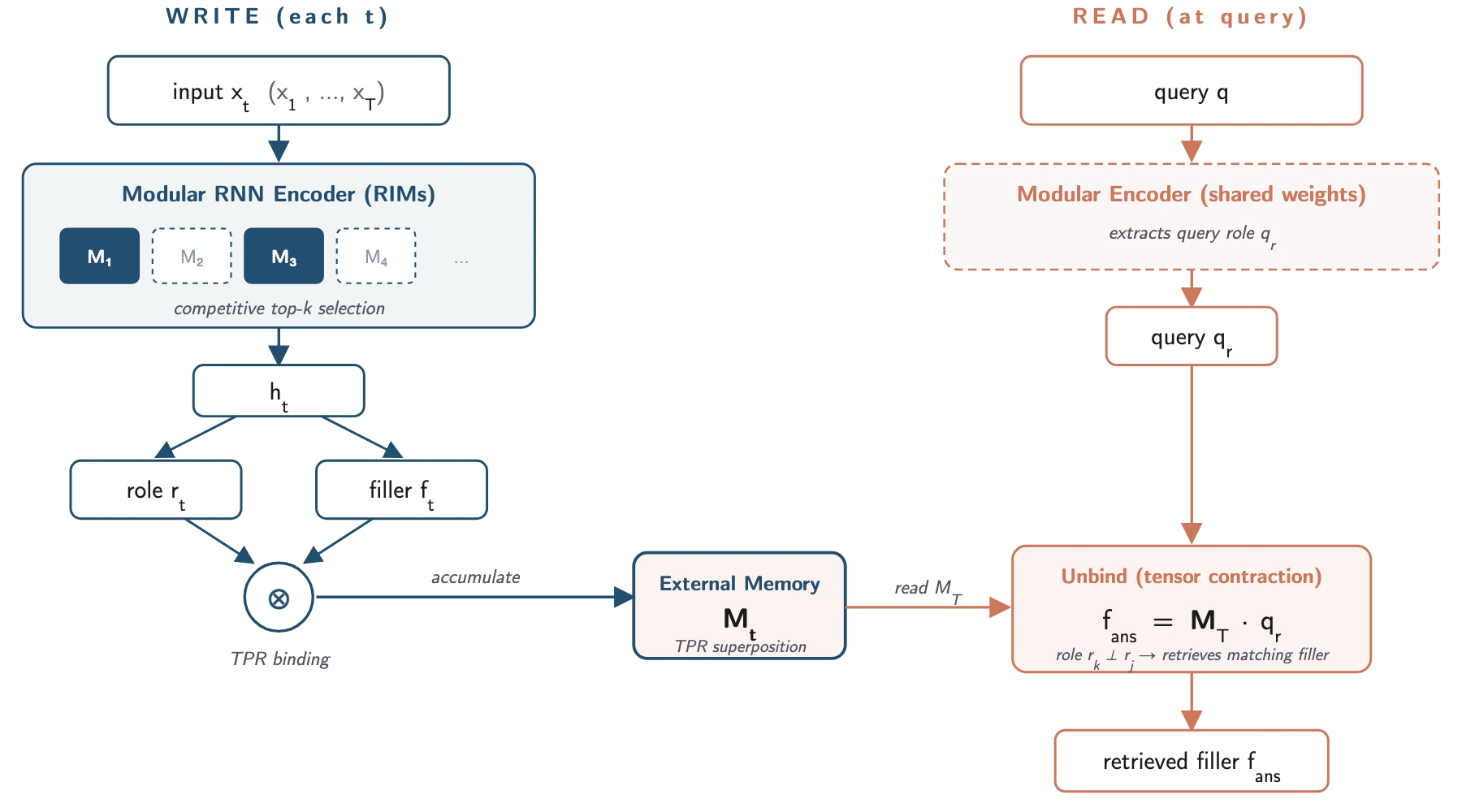
Overall architecture. At each time step $t$, the input passes through the modular encoder and is split into a role $r_t$ and a filler $f_t$; TPR binding ($\otimes$) accumulates them into an external memory $\mathbf{M}_t$. At query time, the same encoder produces a query role $q_r$, which unbinds the target filler from the memory.
Method
Conventional memory augmented neural networks (MANNs) suffer from severe performance degradation on systematically different test data. The core issue is that the encoder overfits to training combinations, failing to represent individual components in a recomposable form. We address this by combining a modular RNN encoder + TPR-based external memory.
Key components:
- Recurrent Independent Mechanisms (RIMs): \(N\) RNN modules learn independent encoding mechanisms via competitive learning
- Tensor Product Representation (TPR): Associations are mathematically bound via tensor products of roles and fillers — \(T = \sum_{k=1}^N \mathbf{r}_k \otimes \mathbf{f}_k\)
- TPR-based External Memory: Role/filler representations are extracted at each time step and superposed into memory. The write rule uses a learned write strength \(\beta = \sigma(W_\beta h_t)\) to form a delta-filler update: \(\mathbf{M}_t = \mathbf{M}_{t-1} + \mathbf{r}_t \otimes (\beta \mathbf{f}_t - (1-\beta) \mathbf{f}_{t-1})\) .
- Systematic Associative Recall (SAR): A new benchmark proposed for evaluating systematic generalization in associative reasoning
Results
Systematic Associative Recall (SAR) Task
SAR is a benchmark proposed in this paper, designed to measure systematic generalization in associative reasoning. It uses three object sets (human names \(S_h\) , fruit names \(S_f\) , number names \(S_n\) ) and constructs systematically different object combinations between training and test data.
Specifically, a subset \(S_h^1\) is associated only with numbers during training, while another subset \(S_h^2\) is associated only with fruits. In the test (different) split, these relationships are reversed: \(S_h^1\) is paired with fruits and \(S_h^2\) with numbers. The difficulty parameter \(p = |S_h^3| / |S_h|\) represents the proportion of objects associated with both sets; smaller values indicate a larger systematic gap between training and test.
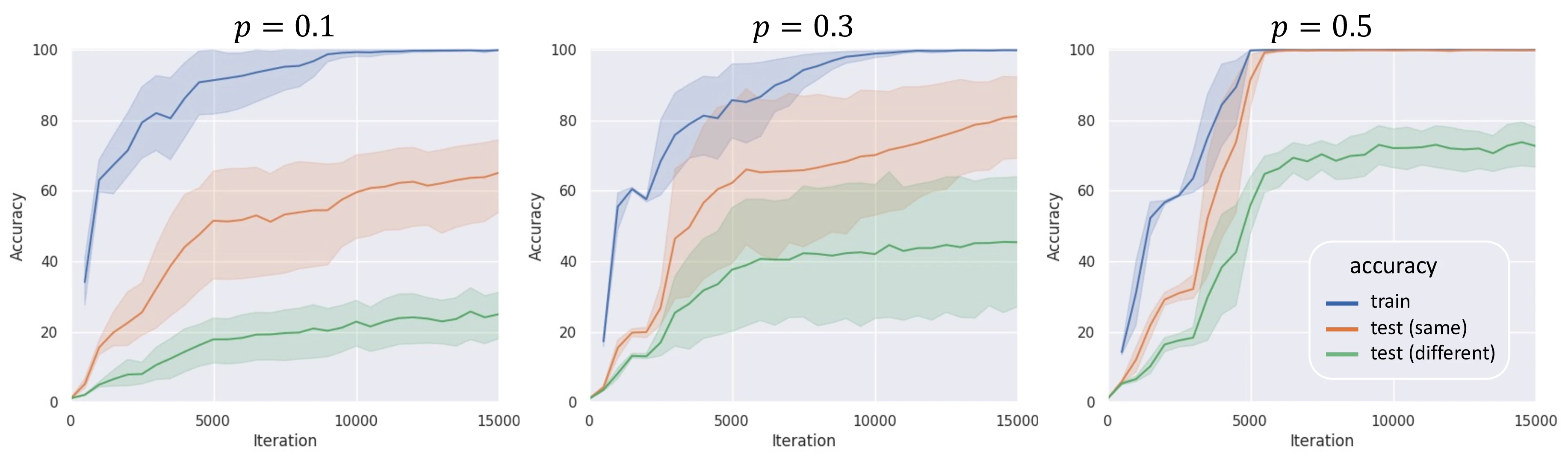
(a) DNC
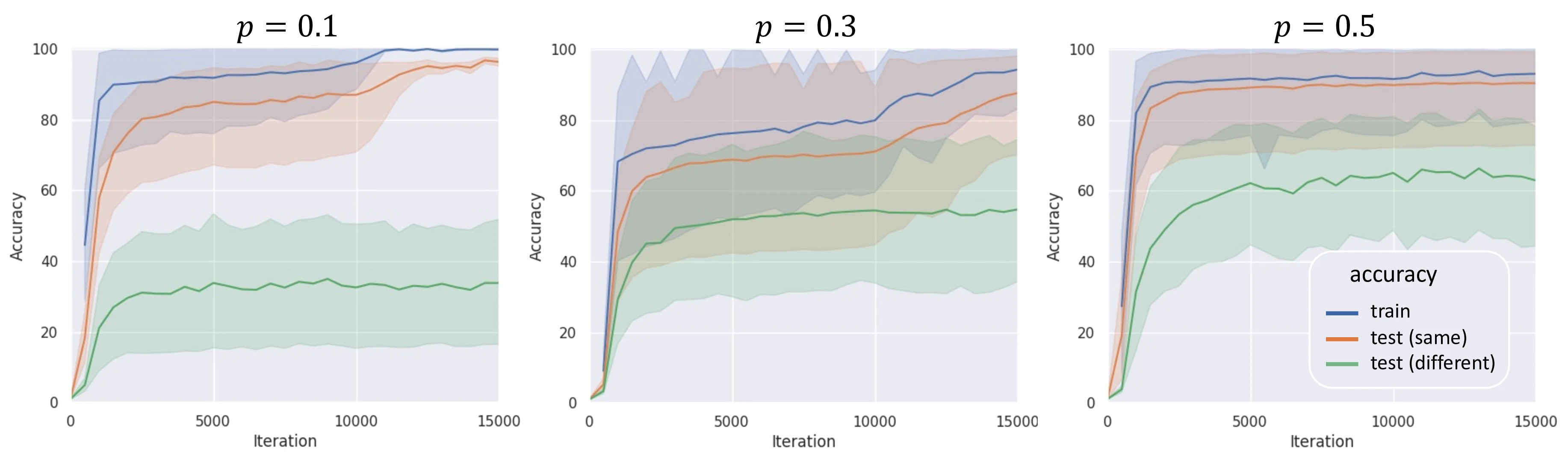
(b) FWM
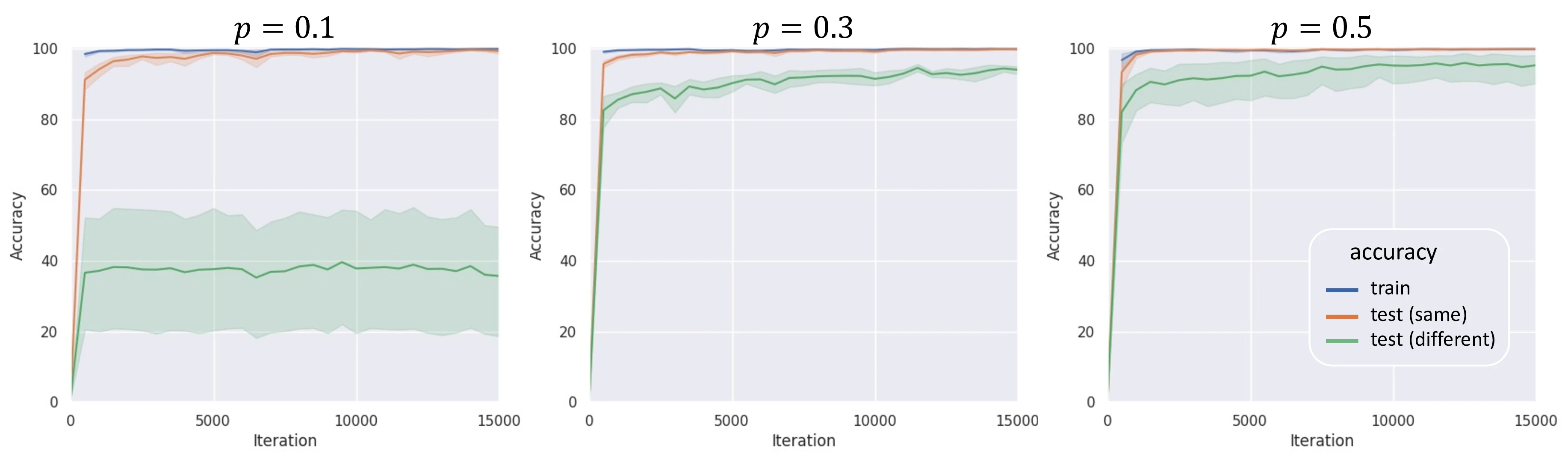
(c) Ours
Training/test accuracy comparison of DNC, FWM, and our proposed method on the SAR task.
DNC and FWM achieve high accuracy on test (same) but show significant degradation on test (different), indicating overfitting to trained combinations and failure at systematic generalization. Our method successfully closes the gap between test (same) and test (different) at \(p=0.3\) and \(p=0.5\) , and shows a substantially smaller gap even at the most difficult setting (\(p=0.1\) ). The fact that FWM fails at systematic generalization despite using TPR-based memory indicates that TPR memory alone is insufficient — learning proper symbolic representations in the encoder is the key factor.
Concatenated-bAbI (catbAbI)
While SAR focuses on systematic generalization, catbAbI evaluates general long-range associative reasoning performance on an infinite-length story sequence question-answering task.
| Model | Test Accuracy |
|---|---|
| LSTM | 80.88% |
| Transformer-XL | 87.66% |
| Meta-learned Neural Memory | 88.97% |
| Fast Weight Memory (FWM) | 96.75% |
| FWM (our trial) | 94.94% |
| Ours | 96.63% |
Under the same experimental setup (our trial), our method (96.63%) outperforms FWM (94.94%) by 1.7pp, and is nearly equivalent to FWM’s official result (96.75%). This demonstrates that introducing the modular encoder adds systematic generalization capability while maintaining state-of-the-art performance on general associative reasoning.
Symbolic Representation Analysis
We verify through two analyses whether the learned representations possess proper symbolic properties.
Role-Unbinding Orthogonality: For correct TPR unbinding, role vectors and unbinding vectors must be orthogonal. FWM exhibits off-diagonal interference in the role-unbinding similarity matrix, while our method shows near-perfect orthogonality. This indicates that the modular encoder learns separable symbolic representations for each object.
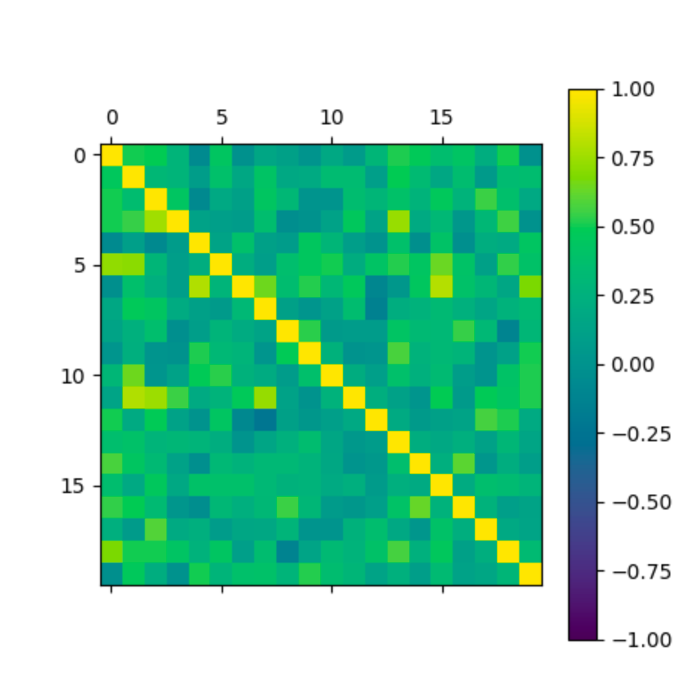
(a) FWM
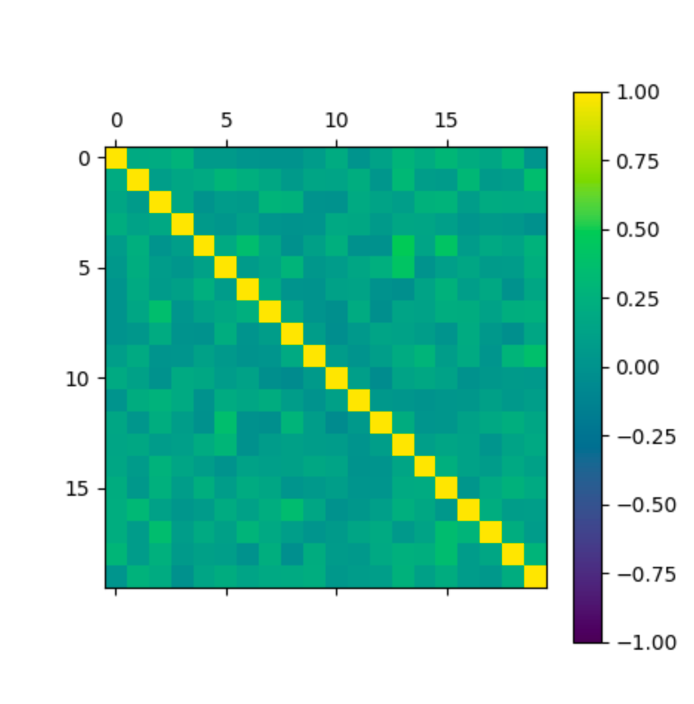
(b) Ours
Similarity matrices between role vectors and unbinding vectors. FWM fails to achieve orthogonality, while our method shows near-perfect orthogonality.
Filler Consistency: For systematic reasoning, querying the same target object should return the same read vector regardless of the combination context. FWM produces different read vectors depending on the combination, while our method returns nearly identical read vectors regardless of context. This provides evidence that the model encodes individual components independently and recombines them for reasoning, rather than memorizing specific combinations.
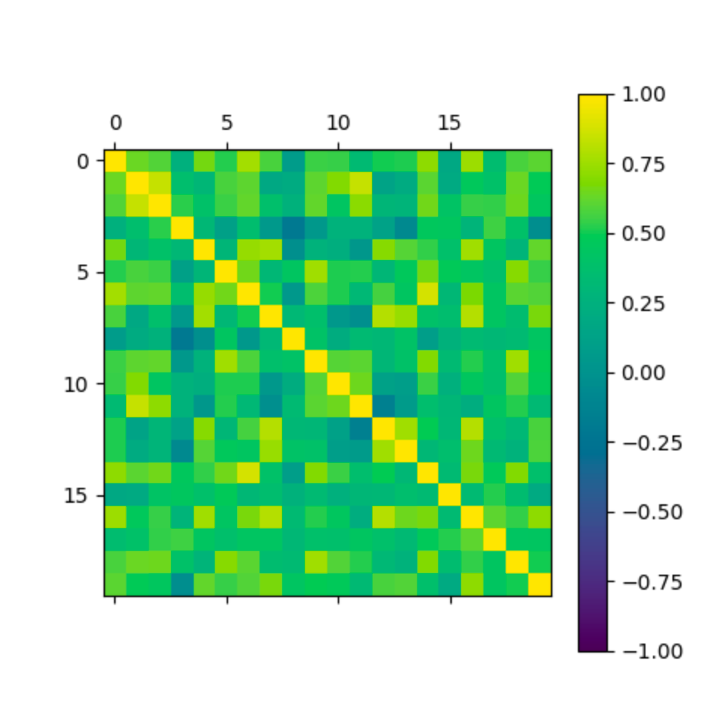
(a) FWM
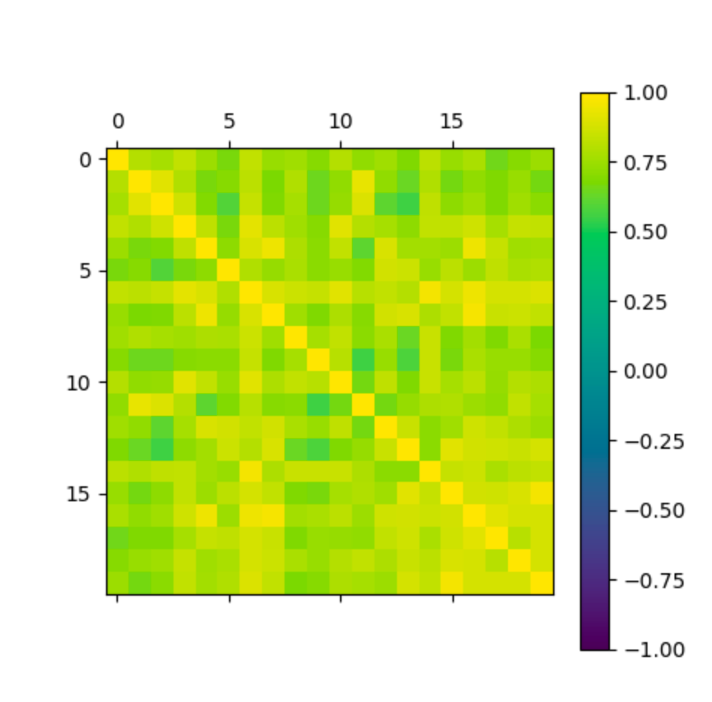
(b) Ours
Similarity between read vectors for the same fruit object. Our method produces consistent outputs regardless of the combination.